6 Unforgettable Ways to Spend a Mountain Camping Night
Picture this: the sun dips behind towering peaks, painting the sky in brilliant oranges and purples, while a gentle breeze carries the crisp scent of pine through your campsite. The day’s heat gives way to cool mountain air, and suddenly, the world transforms into something magical. Mountain camping nights offer experiences that city life simply cannot replicate – moments so profound they become treasured memories for years to come.
Disclosure: This post contains affiliate links. As an Amazon Associate, we earn from qualifying purchases, and at no extra cost to you.
Whether you’re a seasoned outdoor enthusiast or planning your first mountain adventure, discovering the 6 unforgettable ways to spend a mountain camping night can transform an ordinary camping trip into an extraordinary experience. These activities go beyond simply surviving the night; they create connections with nature, fellow campers, and yourself that last long after you return home.
Key Takeaways
- Stargazing in mountain environments provides unparalleled celestial viewing opportunities due to minimal light pollution
- Campfire activities create lasting bonds through storytelling, music, and shared meals under the stars
- Night photography captures the unique beauty of mountain landscapes illuminated by moonlight and stars
- Early morning adventures like sunrise hikes offer breathtaking views and peaceful moments before crowds arrive
- Proper planning and safety measures ensure memorable experiences while maintaining outdoor ethics and personal security
Creating Magical Mountain Camping Memories: The Foundation
Before diving into the specific ways to make mountain camping nights unforgettable, understanding the unique environment becomes essential. Mountain camping presents distinct opportunities that differ dramatically from lowland or coastal camping experiences.
The elevation changes everything – temperatures drop significantly after sunset, air becomes thinner, and weather patterns shift rapidly. However, these challenges also create the perfect conditions for extraordinary experiences. The clear, thin air provides exceptional visibility for stargazing, while the dramatic topography creates stunning sunrise and sunset displays.
Safety preparation forms the cornerstone of any memorable mountain camping experience. This includes:
- Weather monitoring: Mountain weather changes rapidly
- Proper gear selection: Temperature-appropriate sleeping systems and clothing
- Emergency preparedness: First aid supplies and communication devices
- Leave No Trace principles: Protecting the wilderness for future generations
1. Stargazing and Celestial Observation Adventures
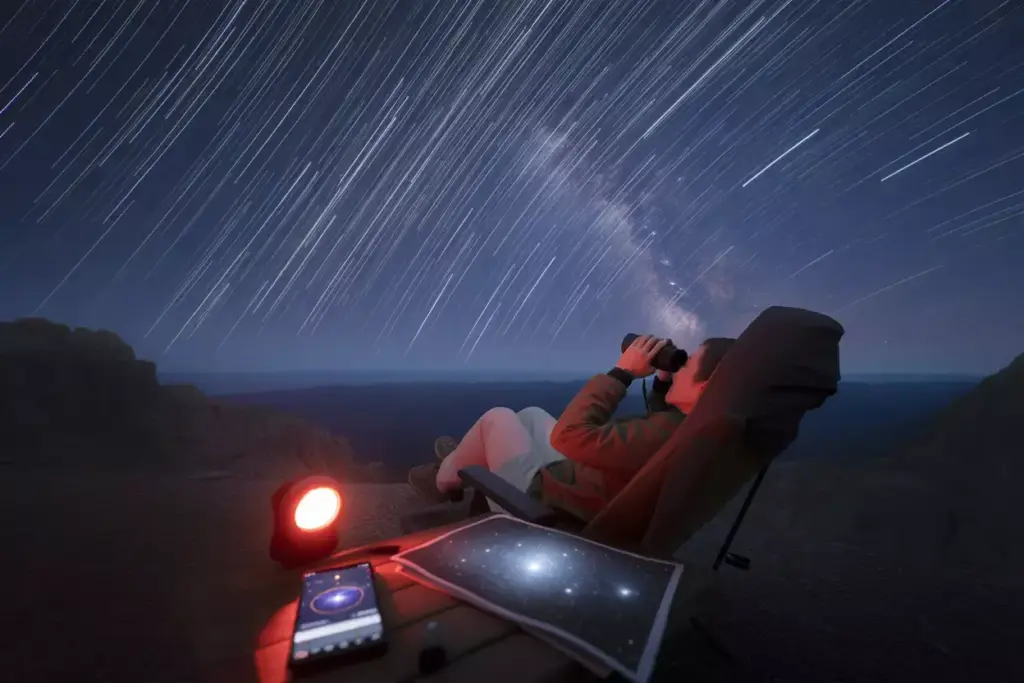
The first of our 6 unforgettable ways to spend a mountain camping night involves looking up. Mountain stargazing offers experiences that urban dwellers rarely witness. At elevation, away from city lights, the night sky reveals its full glory with thousands of visible stars, planets, and celestial phenomena.
Why Mountain Stargazing Stands Apart 🌟
Light pollution affects over 80% of the world’s population, but mountain camping sites often provide Class 1 or Class 2 dark skies – the darkest categories on the Bortle Scale. This means:
- Milky Way visibility: The galaxy’s spiral arms become clearly visible to the naked eye
- Meteor shower enhancement: Shooting stars appear brighter and more frequent
- Planetary observation: Jupiter’s moons and Saturn’s rings become visible with basic telescopes
- Deep space objects: Nebulae and star clusters emerge from the darkness
Essential Stargazing Equipment
| Equipment | Purpose | Recommended Specs |
|---|---|---|
| Red flashlight | Preserves night vision | 1-5 lumens maximum |
| Star chart/app | Constellation identification | SkySafari, Star Walk 2 |
| Binoculars | Enhanced viewing | 7×50 or 10×50 |
| Camping chair | Comfortable positioning | Reclining capability |
| Warm blankets | Temperature comfort | Rated 10°F below expected low |
Prime Stargazing Times and Events
Planning stargazing activities around astronomical events maximizes the experience:
- New moon phases: Darkest skies for deep space observation
- Meteor shower peaks: Perseids (August), Geminids (December), Leonids (November)
- Planetary alignments: When multiple planets appear close together
- International Space Station passes: Bright satellite crossings
Pro Tip: Download offline astronomy apps before heading to areas with limited cell service. Apps like PhotoPills help predict Milky Way positioning for photography planning.
2. Campfire Stories, Music, and Culinary Experiences
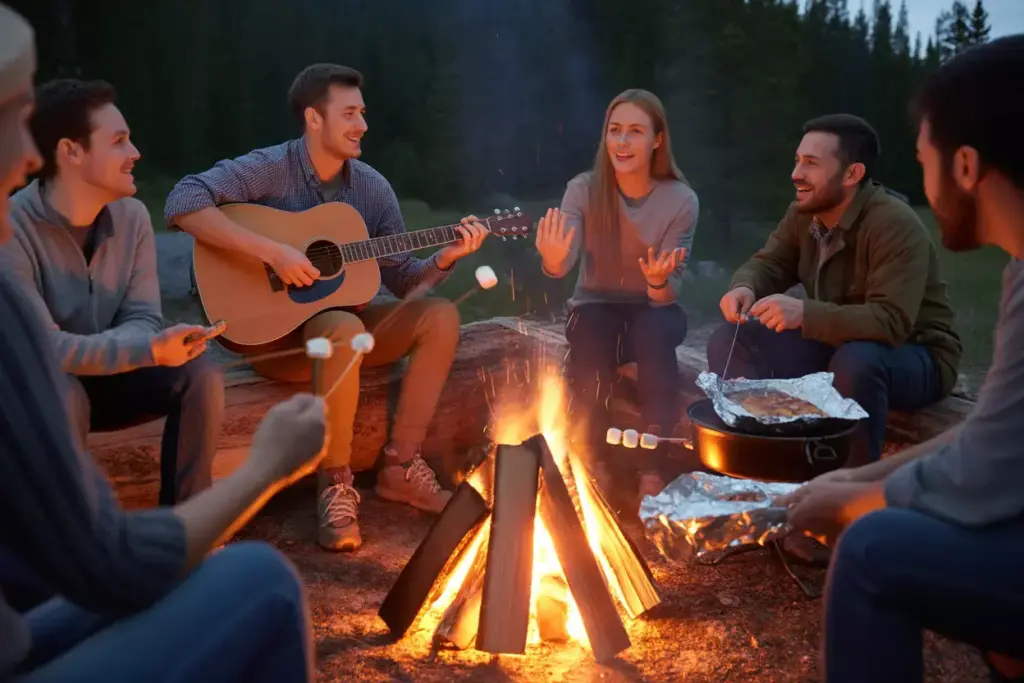
The second way among our 6 unforgettable ways to spend a mountain camping night centers around the ancient human tradition of gathering around fire. Campfires serve multiple purposes: warmth, light, cooking, and most importantly, creating a focal point for human connection and memorable experiences.
The Art of Campfire Storytelling 📖
Storytelling around campfires taps into thousands of years of human tradition. The flickering flames create an intimate atmosphere that encourages sharing, listening, and bonding. Successful campfire storytelling includes:
Traditional Elements:
- Ghost stories: Classic camping tradition that builds excitement
- Personal adventures: Sharing past outdoor experiences and lessons learned
- Local legends: Researching area folklore and historical tales
- Improvised stories: Collaborative storytelling where each person adds elements
Modern Adaptations:
- Photo sharing: Digital storytelling using smartphone images from the day’s adventures
- Trivia games: Nature-themed questions and outdoor knowledge challenges
- Riddles and brain teasers: Mental challenges that engage the group
Mountain Campfire Cooking Adventures
Elevated cooking experiences transform simple meals into memorable feasts. Mountain camping provides unique opportunities for creative outdoor cuisine:
Foil Packet Meals:
- Hobo dinners: Potatoes, vegetables, and protein wrapped in foil
- Dessert packets: Fruit cobblers and s’mores variations
- Breakfast bundles: Eggs, hash browns, and bacon combinations
Dutch Oven Specialties:
- Mountain chili: Hearty one-pot meals perfect for cool evenings
- Campfire bread: Fresh-baked bread using coals for heat regulation
- Cobbler desserts: Fruit desserts that feed large groups
Musical Mountain Moments 🎵
Live music around campfires creates powerful shared experiences. The acoustic properties of mountain environments enhance musical performances:
- Acoustic guitars: Portable and perfect for sing-alongs
- Harmonicas: Easy to pack and learn basic melodies
- Percussion instruments: Shakers, tambourines, and simple drums
- Vocal harmonies: Group singing builds camaraderie
Song Selection Tips:
- Choose familiar songs that encourage group participation
- Include folk songs and traditional camping songs
- Prepare instrumental pieces for quiet reflection moments
- Consider the group’s musical preferences and skill levels
3. Night Photography and Creative Documentation
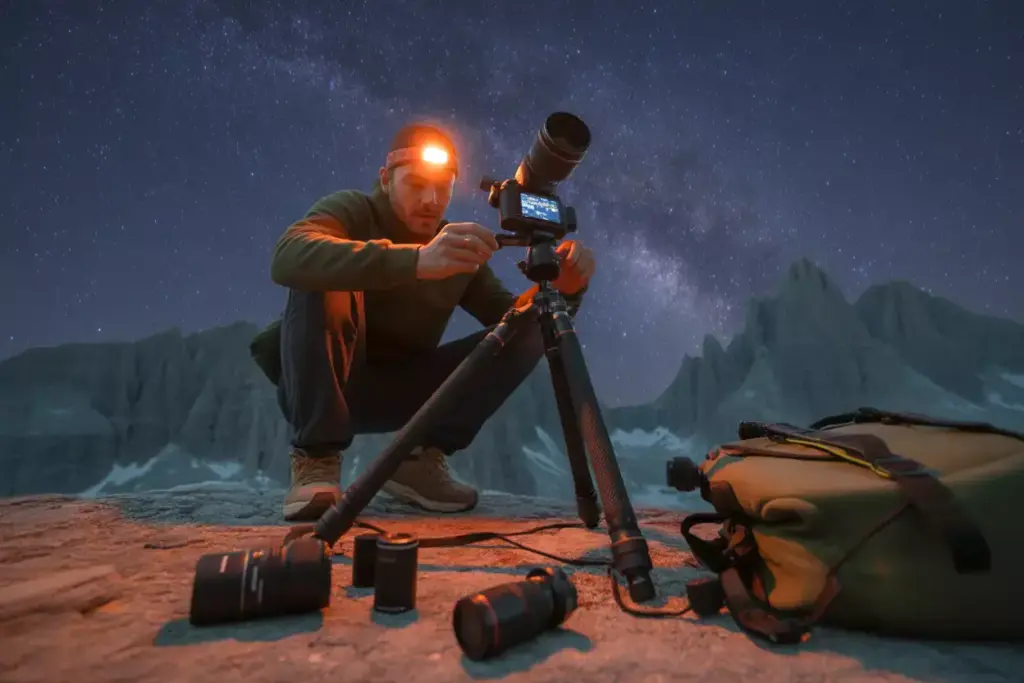
The third of our 6 unforgettable ways to spend a mountain camping night involves capturing the magic through photography. Mountain environments at night offer extraordinary photographic opportunities that challenge skills while creating lasting visual memories.
Essential Night Photography Techniques
Long exposure photography becomes the primary technique for mountain night shots. This involves:
- ISO: Start at 1600-3200, adjust based on camera capabilities
- Aperture: Wide open (f/1.4-f/2.8) for maximum light gathering
- Shutter Speed: 15-30 seconds for star trails, 10-20 seconds for sharp stars
- Focus: Manual focus set to infinity, fine-tuned using live view
Composition Elements:
- Foreground interest: Include tents, trees, or rocks for scale and context
- Leading lines: Use trails, streams, or ridge lines to guide the viewer’s eye
- Rule of thirds: Position horizon lines and key elements strategically
- Silhouettes: Use mountain peaks and trees as dramatic silhouettes
Equipment for Mountain Night Photography
Specialized gear makes the difference between frustrating attempts and successful captures:
| Equipment | Purpose | Key Features |
|---|---|---|
| Sturdy tripod | Camera stability | Carbon fiber for weight savings |
| Remote shutter | Vibration reduction | Intervalometer for time-lapse |
| Extra batteries | Extended power | Cold weather reduces battery life |
| Headlamp | Navigation/setup | Red light mode preserves night vision |
| Lens heater | Prevents condensation | Essential in humid conditions |
Creative Documentation Ideas
Beyond traditional photography, mountain camping nights offer numerous creative documentation opportunities:
Time-lapse Photography:
- Star movement: Capture celestial motion over hours
- Campfire sequences: Document the evening’s activities
- Weather changes: Record cloud movement and atmospheric shifts
Alternative Documentation:
- Sketching and journaling: Artistic interpretation of experiences
- Audio recordings: Capture night sounds and conversations
- Video diaries: Personal reflections and group interactions
Technical Tip: Use the “500 rule” for sharp star photography – divide 500 by your lens focal length to determine maximum shutter speed before star trailing becomes noticeable.
4. Wildlife Observation and Nature Connection
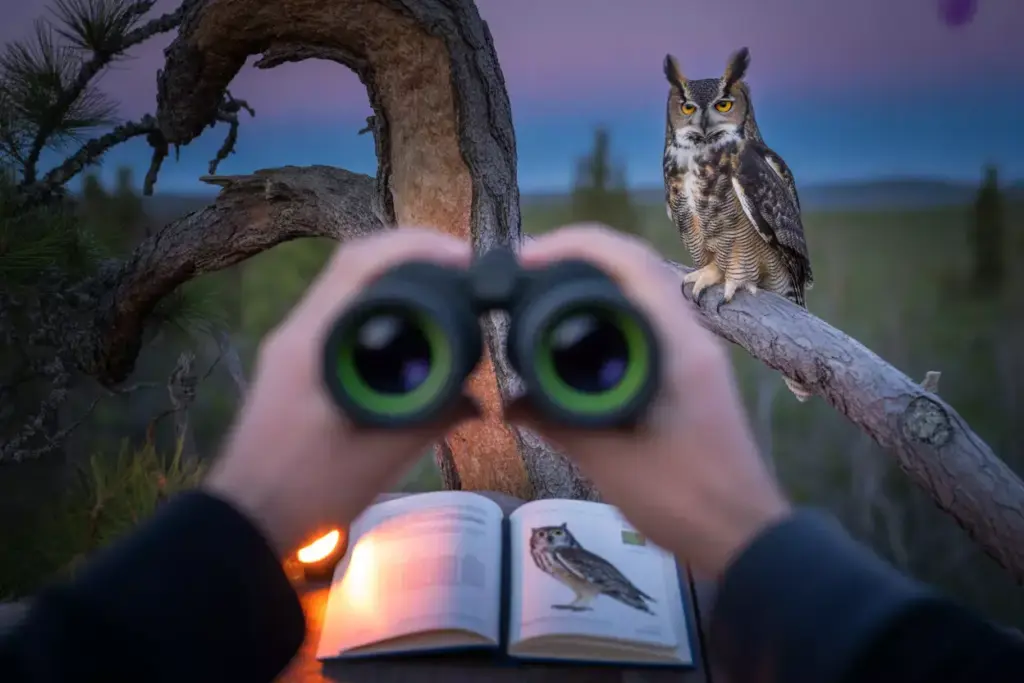
The fourth way to experience unforgettable mountain camping nights involves connecting with the wilderness ecosystem. Mountain environments host diverse wildlife populations that become active during twilight and nighttime hours, offering unique observation opportunities for respectful campers.
Nocturnal Mountain Wildlife
Mountain ecosystems support various nocturnal species that rarely appear during daylight hours:
Common Nocturnal Animals:
- Owls: Great horned owls, spotted owls, and screech owls
- Bats: Multiple species providing natural insect control
- Raccoons: Intelligent scavengers active around campsites
- Deer: Often graze in meadows during early morning and evening hours
- Foxes: Elusive predators that may investigate campsites
Larger Predators (observe from safe distances):
- Bears: Black bears and brown bears depending on region
- Mountain lions: Rarely seen but occasionally present
- Coyotes: Pack hunters with distinctive vocalizations
- Wolves: Present in specific mountain regions
Safe Wildlife Observation Practices 🦉
Responsible wildlife watching protects both animals and campers:
Safety Guidelines:
- Maintain distance: Use binoculars rather than approaching animals
- Secure food storage: Prevent wildlife from associating campsites with food
- Quiet observation: Minimize noise and sudden movements
- No feeding: Never provide food to wild animals
- Respect habitat: Stay on designated trails and camping areas
Observation Equipment:
- Binoculars: 8×42 or 10×42 for versatile wildlife viewing
- Red flashlight: Minimizes disturbance to nocturnal animals
- Field guides: Identify species and understand behaviors
- Camera with telephoto lens: Document sightings from appropriate distances
Understanding Animal Behavior
Interpreting wildlife signs enhances the observation experience:
Tracks and Signs:
- Scat identification: Reveals diet and species presence
- Track patterns: Indicates gait and animal size
- Feeding signs: Claw marks, browse lines, and cached food
- Territorial markers: Scent posts and rubbing trees
Vocalizations:
- Owl calls: Different species have distinctive hooting patterns
- Coyote songs: Pack communication and territorial announcements
- Elk bugles: Seasonal mating calls in appropriate habitats
- Bird dawn chorus: Early morning territorial singing
5. Sunrise Hiking and Early Morning Adventures
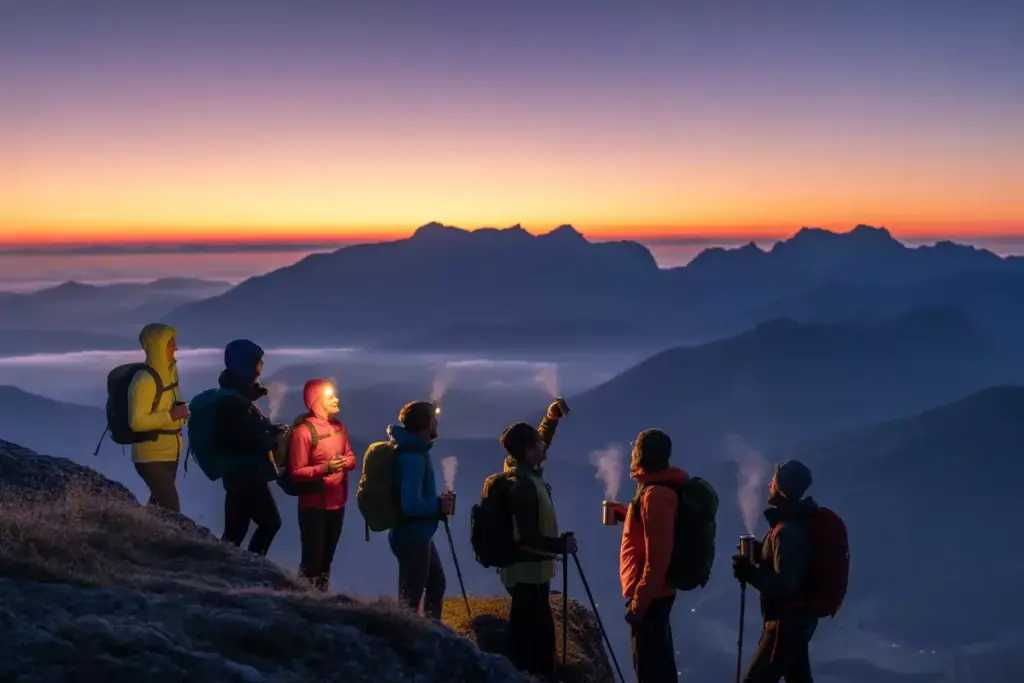
The fifth of our 6 unforgettable ways to spend a mountain camping night technically begins before dawn but represents the culmination of the nighttime experience. Sunrise hiking offers some of the most spectacular and peaceful moments available in mountain environments.
Planning Sunrise Adventures
Successful sunrise hikes require careful planning and preparation:
Timing Considerations:
- Research sunrise times: Use apps like PhotoPills or TimeAndDate.com
- Allow travel time: Factor in hiking duration to viewpoints
- Start early: Begin 1-2 hours before sunrise for best positioning
- Weather monitoring: Clear skies provide optimal viewing conditions
- Nearby viewpoints: Choose destinations within 1-2 hours of camp
- Eastern exposure: Select vantage points facing sunrise direction
- Safety factors: Avoid technical terrain in low-light conditions
- Backup options: Have alternative destinations if weather changes
Essential Sunrise Hiking Gear
Proper equipment ensures safety and comfort during pre-dawn adventures:
| Gear Category | Essential Items | Purpose |
|---|---|---|
| Lighting | Headlamp + backup | Navigation in darkness |
| Clothing | Insulation layers | Temperature regulation |
| Safety | First aid, whistle | Emergency preparedness |
| Navigation | Map, compass, GPS | Route finding |
| Comfort | Thermos, snacks | Energy and warmth |
Maximizing the Sunrise Experience
Creating memorable sunrise moments involves more than simply watching the sun appear:
Photography Opportunities:
- Golden hour lighting: Capture warm, soft illumination on peaks
- Silhouette compositions: Use foreground elements for dramatic effect
- Panoramic sequences: Document the full mountain range
- Time-lapse videos: Record the entire sunrise sequence
Mindfulness Practices:
- Meditation: Use the peaceful morning atmosphere for reflection
- Gratitude exercises: Appreciate the natural beauty and experience
- Journaling: Record thoughts and observations during quiet moments
- Breathing exercises: Connect with the crisp mountain air
Sunrise Tip: Arrive at viewpoints 30 minutes before sunrise to witness the “alpenglow” phenomenon – when mountain peaks glow pink and orange before direct sunlight arrives.
6. Meditation, Reflection, and Personal Growth
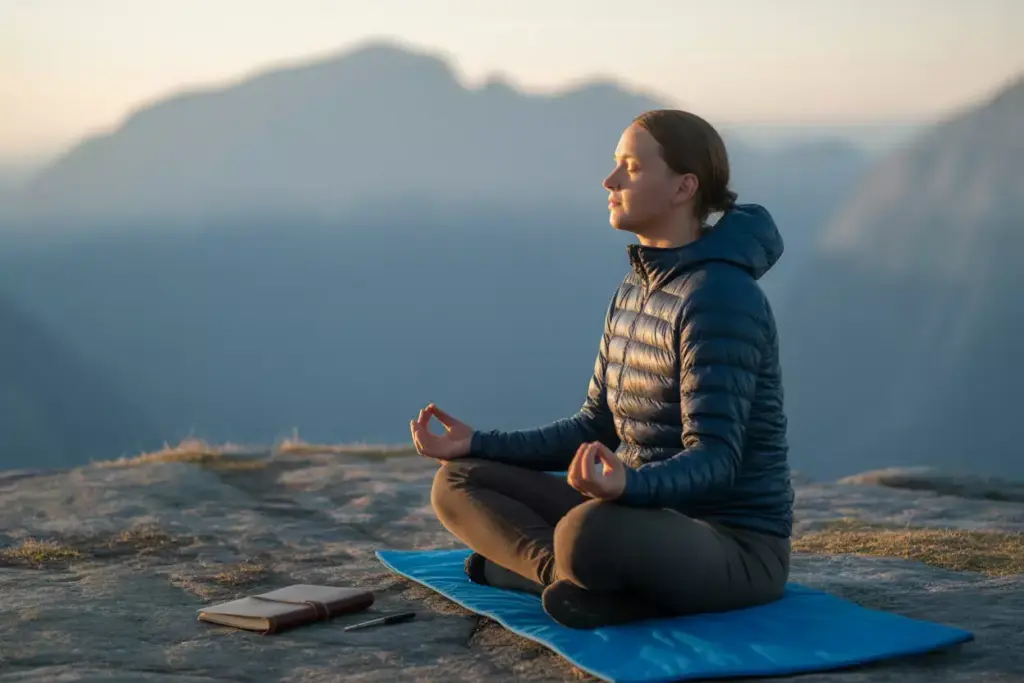
The final way among our 6 unforgettable ways to spend a mountain camping night focuses on inner experiences and personal development. Mountain environments provide ideal settings for introspection, meditation, and meaningful self-reflection away from daily distractions.
The Psychology of Mountain Solitude
Mountain environments offer unique psychological benefits that enhance personal growth experiences:
Mental Health Benefits:
- Stress reduction: Natural settings lower cortisol levels
- Improved focus: Reduced digital distractions enhance concentration
- Emotional regulation: Peaceful environments support emotional processing
- Creativity boost: Novel experiences stimulate creative thinking
- Perspective shifts: Natural grandeur provides life context
Neurological Impacts:
- Default mode network: Reduced activity in brain regions associated with rumination
- Attention restoration: Natural environments restore directed attention capacity
- Memory consolidation: Peaceful settings support memory formation
- Sensory enhancement: Reduced sensory overload improves perception
Meditation Practices for Mountain Camping 🧘♂️
Adapting meditation practices to mountain camping environments creates powerful experiences:
Breathing Meditations:
- 4-7-8 breathing: Inhale for 4, hold for 7, exhale for 8 counts
- Box breathing: Equal counts for inhale, hold, exhale, hold
- Natural rhythm: Sync breathing with natural sounds like wind or water
- Cold air awareness: Focus on the sensation of crisp mountain air
Movement Meditations:
- Walking meditation: Slow, mindful movement around the campsite
- Tai chi practice: Gentle movements in natural settings
- Yoga sequences: Adapted poses for outdoor practice
- Stretching routines: Mindful body awareness exercises
Journaling and Reflection Activities
Structured reflection maximizes the personal growth potential of mountain camping experiences:
Journaling Prompts:
- Daily gratitude: Three specific appreciations from the day
- Challenge reflections: How did difficulties contribute to growth?
- Nature observations: Detailed descriptions of natural phenomena
- Personal insights: What did solitude reveal about priorities and values?
Creative Expression:
- Sketching: Visual documentation of experiences and emotions
- Poetry writing: Capture feelings and observations in verse
- Letter writing: Messages to future self or important people
- Goal setting: Use clarity gained to establish meaningful objectives
Digital Detox Benefits
Disconnecting from technology amplifies the benefits of mountain camping experiences:
Strategies for Digital Detox:
- Airplane mode: Maintain emergency capabilities while reducing distractions
- Designated check times: Brief, scheduled technology use if necessary
- Physical separation: Store devices away from sleeping and relaxation areas
- Alternative activities: Replace screen time with nature-based activities
Observed Benefits:
- Improved sleep quality: Reduced blue light exposure supports natural circadian rhythms
- Enhanced social connection: Face-to-face interactions without digital interruptions
- Increased mindfulness: Present-moment awareness without constant notifications
- Restored attention: Recovery from digital attention fatigue
Safety Considerations for Mountain Camping Nights
Prioritizing safety ensures that unforgettable mountain camping experiences remain positive memories. Mountain environments present unique challenges that require preparation and awareness.
Weather-Related Safety
Mountain weather changes rapidly and can become dangerous without warning:
Preparation Strategies:
- Multi-day forecasts: Monitor weather patterns before and during trips
- Layer systems: Prepare for temperature swings of 30-40°F
- Shelter upgrades: Ensure tents can handle wind and precipitation
- Escape routes: Plan alternative descent routes if weather deteriorates
Wildlife Safety Protocols
Coexisting safely with mountain wildlife requires knowledge and preparation:
Food Storage Requirements:
- Bear canisters: Required in many mountain areas
- Hanging techniques: Proper rope and distance specifications
- Scented items: Store toiletries and cooking materials with food
- Clean camping: Maintain spotless campsites to avoid attracting animals
Emergency Preparedness
Mountain emergencies can develop quickly due to isolation and environmental factors:
Communication Plans:
- Satellite communicators: Devices like Garmin inReach for remote areas
- Emergency contacts: Detailed trip plans left with responsible parties
- Check-in schedules: Regular communication with outside contacts
- Local resources: Knowledge of ranger stations and emergency services
Conclusion
The 6 unforgettable ways to spend a mountain camping night offer transformative experiences that connect us with nature, fellow adventurers, and ourselves. From the awe-inspiring beauty of stargazing in pristine dark skies to the peaceful reflection possible during sunrise hikes, each activity creates lasting memories and personal growth opportunities.
Successful mountain camping requires balancing adventure with safety, spontaneity with preparation, and excitement with respect for the natural environment. These experiences become more meaningful when approached with proper planning, appropriate gear, and a commitment to Leave No Trace principles.
Take action to plan your next mountain camping adventure:
- Research locations that offer the activities most appealing to your interests
- Invest in quality gear that ensures safety and comfort in mountain environments
- Practice new skills like night photography or wildlife identification before your trip
- Plan with others who share your enthusiasm for outdoor adventures
- Book campsites early as popular mountain destinations fill quickly
The mountains are waiting to provide experiences that will enrich your life for years to come. Whether seeking adventure, tranquility, or personal growth, these 6 unforgettable ways to spend a mountain camping night offer pathways to extraordinary memories under starlit skies.