
8 Core-Strengthening Hiking Exercises For Men To Conquer Any Trail
Picture this: You’re halfway up a challenging mountain trail, your legs are burning, but your core feels rock-solid and stable. Every step feels controlled, every steep incline manageable. This isn’t just a dream—it’s the reality for hikers who understand that core strength is the foundation of trail success. The 8 Core-Strengthening Hiking Exercises For Men To Conquer Any Trail outlined in this guide will transform your hiking performance and help you tackle even the most demanding terrain with confidence.
Disclosure: This post contains affiliate links. As an Amazon Associate, we earn from qualifying purchases, and at no extra cost to you.
A strong core isn’t just about looking good—it’s about functional strength that translates directly to better hiking performance. Your core muscles act as a natural weight belt, stabilizing your spine while carrying a heavy backpack and maintaining balance on uneven terrain. Without proper core conditioning, even experienced hikers struggle with fatigue, poor posture, and increased injury risk on challenging trails.
Key Takeaways
- Core strength directly impacts hiking performance by improving balance, stability, and endurance on challenging terrain
- These 8 targeted exercises can be performed anywhere and require minimal equipment while delivering maximum trail-ready results
- Progressive training from basic to advanced movements ensures continuous improvement and prevents plateaus
- Functional movements mirror real hiking demands, making your training time more effective
- Consistent practice of these exercises will reduce fatigue and injury risk while increasing your trail confidence
Why Core Strength Matters for Male Hikers
Core strength serves as the powerhouse of hiking performance. When carrying a loaded backpack up steep terrain, your core muscles work overtime to maintain proper posture and prevent back strain. Research shows that hikers with stronger cores experience 40% less lower back pain and demonstrate significantly better balance on technical terrain.
The core muscle group includes more than just your abs. It encompasses:
- Diaphragm (top of the core)
- Pelvic floor muscles (bottom of the core)
- Multifidus (deep back muscles)
- Transverse abdominis (deep abdominal muscles)
- Internal and external obliques (side muscles)
- Rectus abdominis (the “six-pack” muscles)
For male hikers specifically, developing core strength addresses common challenges like:
🎯 Heavy pack stability – Men often carry heavier loads, requiring stronger core engagement
🎯 Upper body power transfer – Core strength helps transfer power from legs to upper body during scrambling
🎯 Injury prevention – Strong cores reduce the risk of lower back injuries common in male hikers
🎯 Endurance enhancement – Better core stability means less energy wasted on unnecessary movement
“A strong core is like having a built-in suspension system for your spine. It absorbs shock, maintains alignment, and keeps you moving efficiently mile after mile.” – Dr. Sarah Mitchell, Sports Medicine Specialist
Essential Core Training Principles for Hikers
Before diving into the 8 Core-Strengthening Hiking Exercises For Men To Conquer Any Trail, understanding proper training principles ensures maximum effectiveness and safety.
Progressive Overload
Start with basic movements and gradually increase:
- Duration (hold planks longer)
- Repetitions (more mountain climbers)
- Complexity (single-limb variations)
- Resistance (weighted movements)
Functional Movement Patterns
Choose exercises that mirror hiking demands:
- Anti-extension (resisting backward bending)
- Anti-flexion (resisting forward bending)
- Anti-rotation (resisting twisting)
- Dynamic stability (maintaining control during movement)
Training Frequency
For optimal results, follow this schedule:
| Training Phase | Frequency | Duration | Focus |
|---|---|---|---|
| Beginner | 3x per week | 15-20 minutes | Form and endurance |
| Intermediate | 4x per week | 20-30 minutes | Strength and stability |
| Advanced | 5x per week | 30-40 minutes | Power and complexity |
The 8 Core-Strengthening Hiking Exercises For Men To Conquer Any Trail: Foundation Movements
These first four exercises form the foundation of your core training program. Master these movements before progressing to advanced variations.
1. Mountain Climbers with Perfect Form

Mountain climbers directly simulate the leg drive and core stability needed for steep ascents. This dynamic exercise builds both strength and cardiovascular endurance.
Setup and Execution:
- Start in a high plank position with hands directly under shoulders
- Keep your core tight and body in a straight line
- Drive one knee toward your chest while keeping the other leg extended
- Quickly switch legs, maintaining controlled movement
- Keep hips level throughout the movement
Hiking-Specific Benefits:
- Improves leg turnover for efficient climbing
- Builds cardiovascular endurance for long ascents
- Strengthens hip flexors crucial for high steps
- Develops core stability under dynamic conditions
Progression Guidelines:
- Beginner: 3 sets of 20 seconds, 30-second rest
- Intermediate: 4 sets of 30 seconds, 20-second rest
- Advanced: 5 sets of 45 seconds, 15-second rest
2. Plank Variations for Trail Stability

The plank family of exercises builds the isometric strength essential for maintaining proper posture while hiking with a heavy pack.
Standard Plank Progression:
Week 1-2: Basic Plank
- Hold for 30-60 seconds
- Focus on perfect alignment
- Breathe normally throughout
Week 3-4: Single-Arm Plank
- Lift one arm for 15 seconds
- Switch arms
- Increases anti-rotation demands
Week 5-6: Plank with Leg Lifts
- Lift one leg 6 inches off ground
- Hold for 10 seconds, switch legs
- Mimics single-leg hiking stability
Common Mistakes to Avoid:
❌ Allowing hips to sag or pike up
❌ Holding breath during the exercise
❌ Placing hands too wide or narrow
❌ Looking up instead of maintaining neutral neck
3. Russian Twists for Rotational Power

Russian twists develop the rotational strength needed for navigating switchbacks and maintaining balance on uneven terrain.
Proper Technique:
- Sit with knees bent, feet slightly off the ground
- Lean back to create a V-shape with your torso and thighs
- Clasp hands together or hold a weight
- Rotate your torso left and right, touching the ground beside your hips
- Keep your core engaged throughout
Trail Applications:
- Switchback navigation with heavy packs
- Balance recovery on loose terrain
- Lateral stability during stream crossings
- Pack adjustment while maintaining forward momentum
Intensity Progressions:
- Bodyweight only – Focus on form and control
- Water bottle – Add 1-2 pounds of resistance
- Medicine ball – Increase to 5-10 pounds
- Single-leg variation – Ultimate challenge for stability
4. Dead Bug Exercise for Deep Core Activation

The dead bug exercise targets the deep core muscles that provide spinal stability during long hikes with heavy loads.
Step-by-Step Instructions:
- Lie on your back with arms extended toward the ceiling
- Bend hips and knees to 90 degrees
- Slowly lower opposite arm and leg toward the floor
- Stop just before touching the ground
- Return to starting position with control
- Repeat with opposite arm and leg
Why Dead Bugs Matter for Hikers:
- Teaches independent limb movement while maintaining core stability
- Improves coordination between upper and lower body
- Builds endurance in deep stabilizing muscles
- Reduces lower back stress during long hikes
Performance Standards:
- Beginner: 2 sets of 8 reps per side, slow and controlled
- Intermediate: 3 sets of 12 reps per side, add 2-second holds
- Advanced: 4 sets of 15 reps per side, add resistance bands
Advanced Core Training: The 8 Core-Strengthening Hiking Exercises For Men To Conquer Any Trail
Once you’ve mastered the foundation movements, these advanced exercises will take your core strength to the next level, preparing you for the most challenging trails.
5. Bear Crawls for Full-Body Integration

Bear crawls combine core stability, coordination, and strength in a movement pattern that directly translates to scrambling and technical terrain navigation.
Execution Protocol:
- Start on hands and knees with knees 1 inch off the ground
- Keep your back flat and core engaged
- Move opposite hand and foot forward simultaneously
- Take small, controlled steps
- Maintain knee height throughout the movement
Training Variables:
- Forward bear crawls – Build basic strength and coordination
- Backward bear crawls – Challenge stability and spatial awareness
- Lateral bear crawls – Develop side-to-side stability
- Bear crawl holds – Build isometric endurance
Hiking Performance Benefits:
🏔️ Scrambling ability – Direct transfer to rock and root navigation
🏔️ Pack stability – Maintains load control during technical sections
🏔️ Fatigue resistance – Builds work capacity for long trail days
🏔️ Confidence – Improves comfort on challenging terrain
6. Single-Leg Deadlifts with Core Focus

Single-leg deadlifts develop the unilateral strength and stability essential for navigating uneven trail surfaces and maintaining balance on technical terrain.
Proper Form Checklist:
✅ Stand on one leg with slight knee bend
✅ Hinge at the hips, reaching toward the ground
✅ Keep your back straight and core tight
✅ Extend the free leg behind you for balance
✅ Return to standing with control
Progression Pathway:
- Bodyweight only – Master the movement pattern
- Light dumbbells – Add 10-15 pounds total
- Single dumbbell – Increase anti-rotation challenge
- Unstable surface – Perform on foam pad or BOSU ball
Real-World Applications:
- Stream crossings on slippery rocks
- Root and rock navigation with precise foot placement
- Steep descents requiring controlled single-leg loading
- Pack retrieval while maintaining balance
7. Turkish Get-Ups for Total Body Power
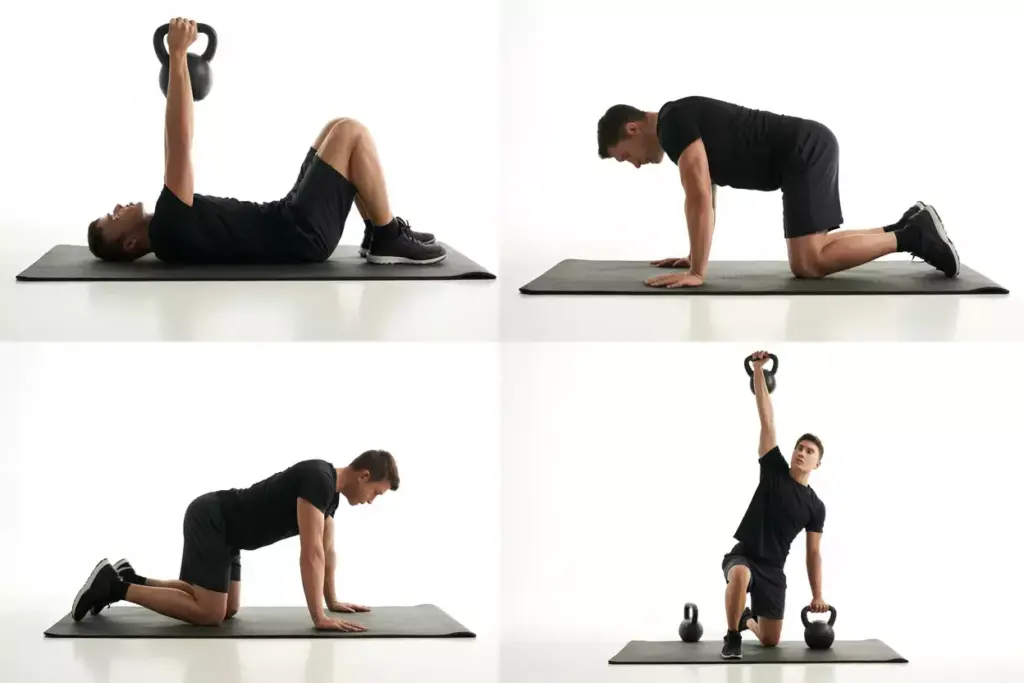
The Turkish get-up is the ultimate functional exercise for hikers, combining mobility, stability, and strength in one complex movement.
The Seven Steps of a Turkish Get-Up:
- Start position – Lie down holding weight in right hand, right knee bent
- Roll to elbow – Press up to right elbow, keeping weight stable
- Hand to high sit – Press to right hand, creating space
- Hip bridge – Lift hips, sweep left leg under body
- Knee position – Come to kneeling lunge position
- Stand up – Rise to standing position with weight overhead
- Reverse the process – Return to starting position with control
Why Turkish Get-Ups Transform Hiking Performance:
- Ground-to-standing transitions common in camping and rest stops
- Overhead stability for pack loading and gear management
- Multi-planar movement that mirrors real-world demands
- Unilateral strength that addresses muscle imbalances
Training Recommendations:
- Start with bodyweight only until movement is smooth
- Progress to light weight (5-10 pounds) focusing on control
- Perform 3-5 reps per side with perfect form
- Practice daily for best results
8. Hanging Leg Raises for Advanced Core Power

Hanging leg raises develop the upper core strength needed for sustained pack carrying and the grip strength essential for scrambling sections.
Exercise Variations by Skill Level:
Beginner: Knee Raises
- Hang from pull-up bar with bent knees
- Lift knees toward chest
- Lower with control
- Focus on preventing swing
Intermediate: Straight Leg Raises
- Keep legs straight throughout movement
- Lift to hip level
- Emphasize controlled lowering phase
- Maintain shoulder stability
Advanced: Toes to Bar
- Touch toes to the bar
- Require significant core and grip strength
- Ultimate test of functional power
- Builds elite-level hiking strength
Grip Strength Benefits:
Strong grip strength from hanging exercises directly improves:
- Trekking pole efficiency during long descents
- Rock scrambling ability on technical terrain
- Pack handling during loading and adjustments
- Safety during emergency situations requiring hand strength
Creating Your Personal Training Schedule
To maximize the benefits of these 8 Core-Strengthening Hiking Exercises For Men To Conquer Any Trail, follow a structured training schedule that builds progressively toward your hiking goals.
Sample 4-Week Progression Plan
Week 1: Foundation Building
- Monday: Exercises 1-4 (foundation movements)
- Wednesday: Exercises 1-4 with increased duration
- Friday: Exercises 1-4 plus light cardio
- Focus: Perfect form and movement patterns
Week 2: Strength Development
- Monday: Exercises 1-4 with increased reps
- Tuesday: Exercises 5-6 (bear crawls and single-leg deadlifts)
- Thursday: Full routine, exercises 1-6
- Saturday: Light practice of all movements
Week 3: Power Integration
- Monday: Exercises 1-4 (advanced variations)
- Tuesday: Exercises 5-8 (all advanced movements)
- Thursday: Complete routine with increased intensity
- Friday: Active recovery with light movement
- Sunday: Full practice session
Week 4: Peak Performance
- Monday: High-intensity complete routine
- Tuesday: Focus on weakest movements
- Wednesday: Active recovery
- Thursday: Time-based challenges
- Saturday: Complete assessment and testing
Measuring Progress and Success
Track your improvement using these measurable benchmarks:
| Exercise | Beginner Goal | Intermediate Goal | Advanced Goal |
|---|---|---|---|
| Mountain Climbers | 30 seconds | 60 seconds | 90 seconds |
| Plank Hold | 60 seconds | 2 minutes | 3 minutes |
| Russian Twists | 20 reps | 40 reps | 60 reps |
| Dead Bugs | 8 per side | 12 per side | 15 per side |
| Bear Crawl | 10 steps | 20 steps | 30 steps |
| Single-Leg Deadlift | 8 per side | 12 per side | 15 per side |
| Turkish Get-Up | 3 per side | 5 per side | 8 per side |
| Hanging Leg Raises | 5 reps | 10 reps | 15 reps |
Conclusion
The 8 Core-Strengthening Hiking Exercises For Men To Conquer Any Trail presented in this guide provide a comprehensive foundation for building the functional strength needed to excel on any hiking adventure. From basic planks to advanced Turkish get-ups, each exercise serves a specific purpose in developing the core stability, rotational power, and unilateral strength that separate confident trail hikers from those who struggle with challenging terrain.
Your next steps are clear:
- Start with the foundation exercises (1-4) and master proper form before progressing
- Follow the 4-week progression plan to build strength systematically
- Track your progress using the measurable benchmarks provided
- Gradually incorporate advanced movements (5-8) as your strength improves
- Maintain consistency with 3-5 training sessions per week
Remember that core strength development is a journey, not a destination. The hikers who consistently practice these movements will find themselves tackling steeper trails, carrying heavier packs, and hiking longer distances with greater confidence and less fatigue. Whether you’re preparing for a weekend backpacking trip or planning a multi-day wilderness adventure, these exercises will provide the foundation you need to conquer any trail that lies ahead.
Start your core training journey today, and experience the difference that functional strength makes on your next hiking adventure. Your back, your balance, and your trail confidence will thank you for the investment.