8 Mountain Trekking Photography Tips for Stunning Landscape Shots
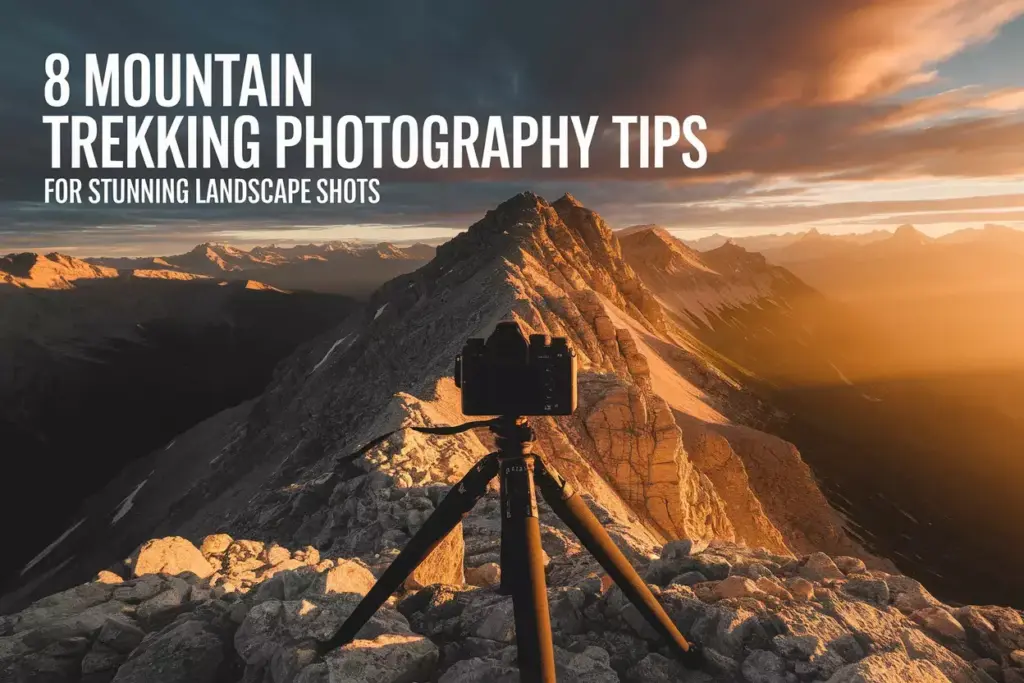
Picture this: You’ve hiked for hours through rugged terrain, your legs burning with each step, only to reach a breathtaking mountain vista that leaves you speechless. The golden light dances across towering peaks, casting dramatic shadows into deep valleys below. You reach for your camera, eager to capture this magical moment—but the resulting photo falls flat, failing to convey even a fraction of the awe-inspiring beauty you witnessed. Sound familiar? Mountain photography presents unique challenges that can frustrate even experienced photographers, but mastering these 8 Mountain Trekking Photography Tips for Stunning Landscape Shots will transform your outdoor adventures into a portfolio of breathtaking images.
Key Takeaways
- Master the golden hour by planning your trek to reach viewpoints during sunrise or sunset for optimal lighting conditions
- Pack lightweight, essential gear including a sturdy tripod, extra batteries, and weather protection for your equipment
- Use proper composition techniques like the rule of thirds, leading lines, and foreground elements to create depth and visual interest
- Understand mountain weather patterns and how they affect lighting, visibility, and safety during photography sessions
- Focus on storytelling by capturing both wide landscapes and intimate details that convey the complete mountain experience
Essential Equipment for Mountain Photography Success
1. Camera Body and Lens Selection
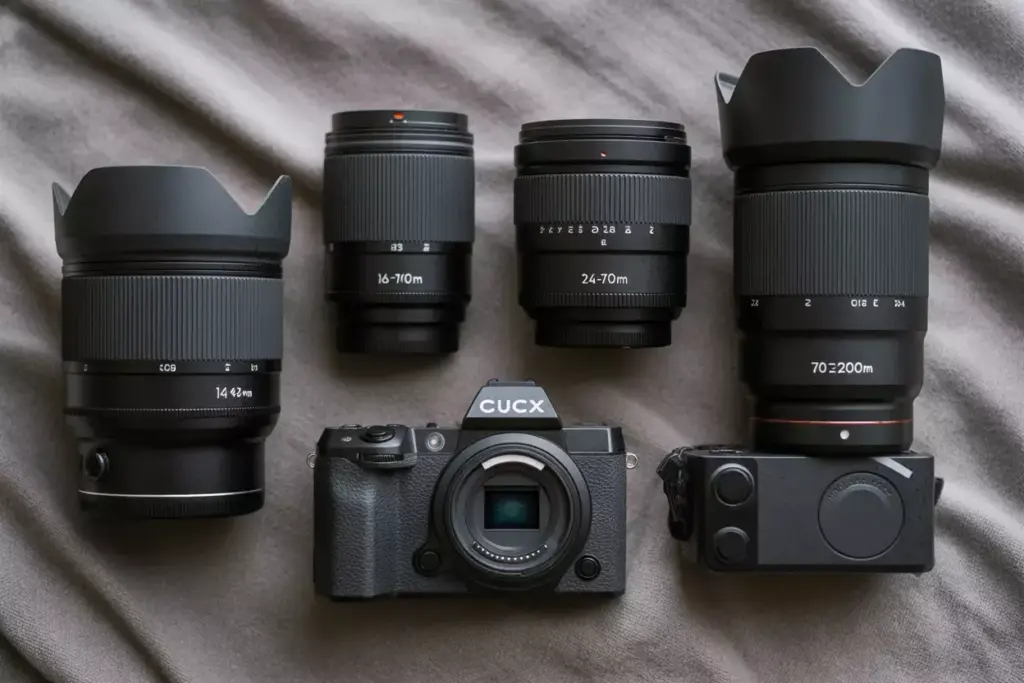
Choosing the right camera equipment for mountain trekking requires balancing image quality with portability. Mirrorless cameras have become increasingly popular among mountain photographers due to their lighter weight compared to traditional DSLRs while maintaining excellent image quality. The reduced bulk becomes crucial when every ounce matters during long treks.
Wide-angle lenses (14-24mm) are essential for capturing expansive mountain vistas, allowing photographers to include dramatic foreground elements while showcasing the grandeur of distant peaks. A versatile zoom lens (24-70mm) serves as an excellent all-around option for various compositions, from sweeping landscapes to isolated mountain features.
Key lens recommendations:
- Ultra-wide zoom: 14-24mm f/2.8 for dramatic landscapes
- Standard zoom: 24-70mm f/2.8 for versatility
- Telephoto zoom: 70-200mm f/4 for distant peaks and compression effects
2. Tripod and Stabilization Systems
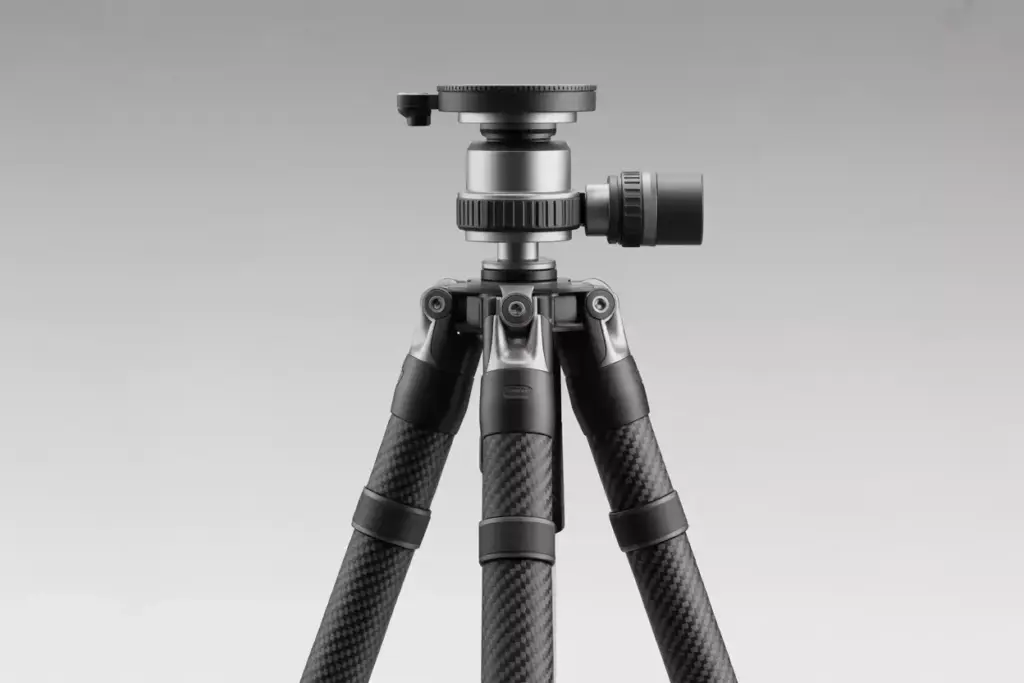
A lightweight carbon fiber tripod represents one of the most critical investments for serious mountain photographers. While the added weight might seem burdensome during ascents, the stability provided becomes invaluable for sharp images during golden hour conditions when longer exposures are necessary.
Modern travel tripods offer impressive stability while folding down to compact sizes suitable for backpack attachment. Look for models with twist-lock legs that perform better in cold conditions compared to flip-lock mechanisms, which can become brittle in freezing temperatures.
Tripod selection criteria:
- Weight: Under 3 pounds for extended treks
- Height: Extends to eye level when fully deployed
- Stability: Supports 2-3 times your camera/lens weight
- Durability: Weather-sealed joints and corrosion-resistant materials
Mastering Light and Timing in Mountain Environments
3. Golden Hour Planning and Execution
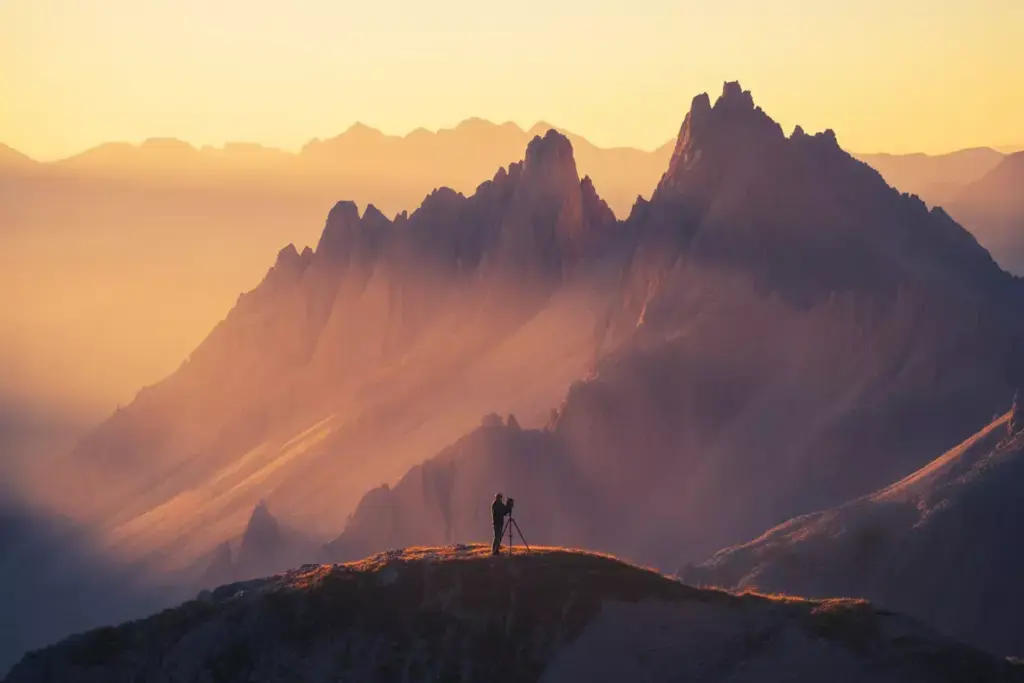
Understanding mountain lighting patterns separates amateur snapshots from professional-quality landscape photographs. The golden hour—the period shortly after sunrise and before sunset—provides warm, soft light that enhances mountain textures and creates dramatic shadow play across rocky surfaces.
Mountain environments present unique lighting challenges due to elevation changes and weather patterns. Peaks can block direct sunlight earlier than expected, while reflected light from snow-covered surfaces can provide beautiful fill lighting even in shadowed areas. Successful mountain photographers study topographic maps and use sun tracking apps to predict optimal lighting conditions for specific viewpoints.
Golden hour strategies:
- Arrive early: Reach shooting locations 30-45 minutes before optimal light
- Scout compositions: Use blue hour light to identify foreground elements
- Multiple exposures: Bracket shots as light changes rapidly
- Post-sunset opportunities: Don’t pack up immediately—alpenglow can create magical conditions
4. Weather Pattern Recognition
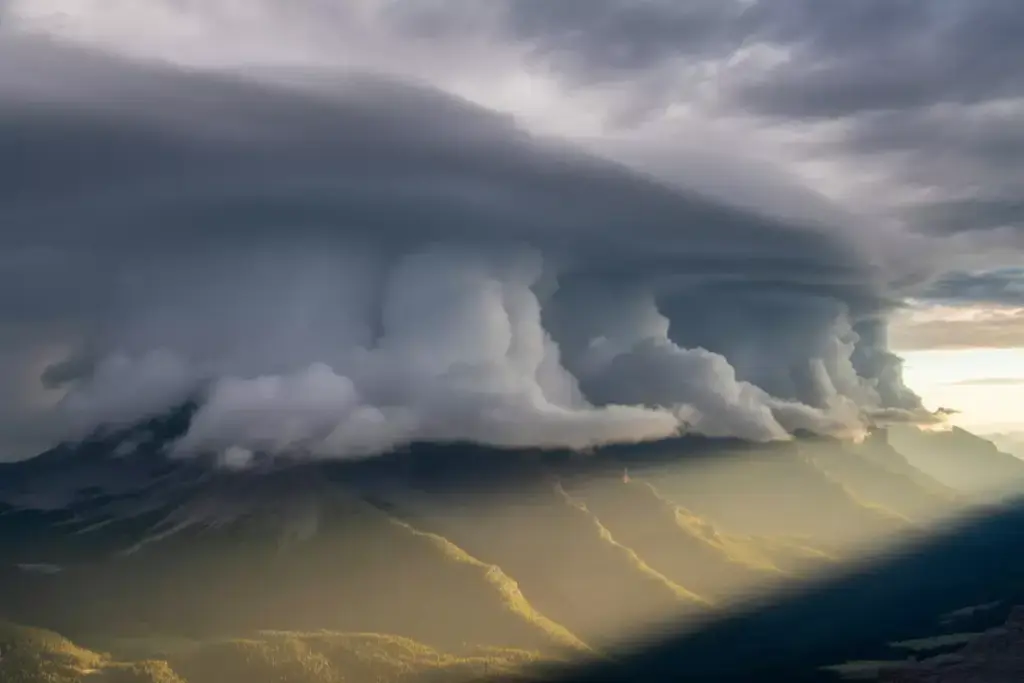
Mountain weather changes rapidly, creating both challenges and opportunities for photographers. Understanding cloud formations, wind patterns, and precipitation cycles allows photographers to anticipate dramatic lighting conditions and ensure equipment safety.
Orographic lifting causes air masses to rise over mountain ranges, creating clouds and precipitation on windward slopes while leaving leeward areas clear. This phenomenon can create stunning dramatic skies with defined cloud layers that add visual interest to compositions.
Weather photography opportunities:
- Storm clearing: Dramatic light breaks through dissipating clouds
- Fog and mist: Creates mysterious, ethereal mountain scenes
- Snow conditions: Fresh snow enhances contrast and simplifies compositions
- Temperature inversions: Fog-filled valleys with peaks emerging above clouds
Advanced Composition Techniques for Mountain Landscapes
5. Foreground, Middle Ground, and Background Balance
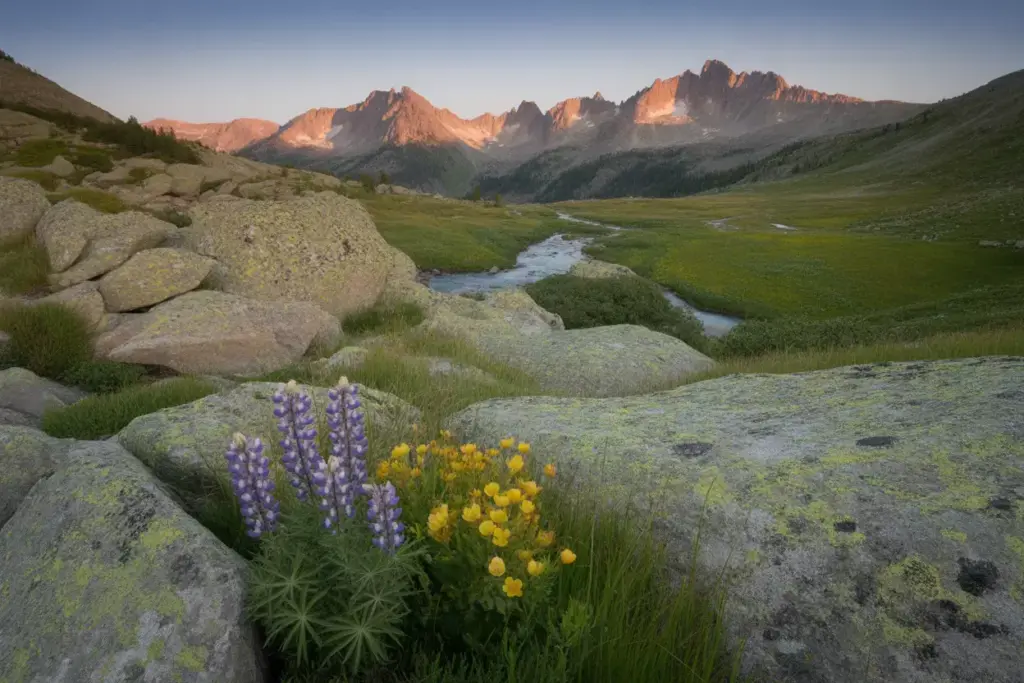
Creating compelling mountain compositions requires careful attention to visual depth through strategic use of foreground elements. Unlike simple mountain snapshots that focus solely on distant peaks, professional landscape photographs guide viewers’ eyes through multiple layers of the scene.
Foreground elements such as alpine flowers, weathered rocks, or mountain streams provide visual anchors that lead viewers into the composition. These elements should complement rather than compete with the main subject while adding context about the mountain environment.
Composition layering techniques:
- Strong foreground: Use wide apertures (f/8-f/11) for optimal sharpness throughout
- Leading lines: Natural features like ridgelines or streams guide visual flow
- Scale indicators: Include recognizable objects to convey mountain grandeur
- Color harmony: Balance warm and cool tones across composition layers
6. Advanced Framing and Perspective Techniques
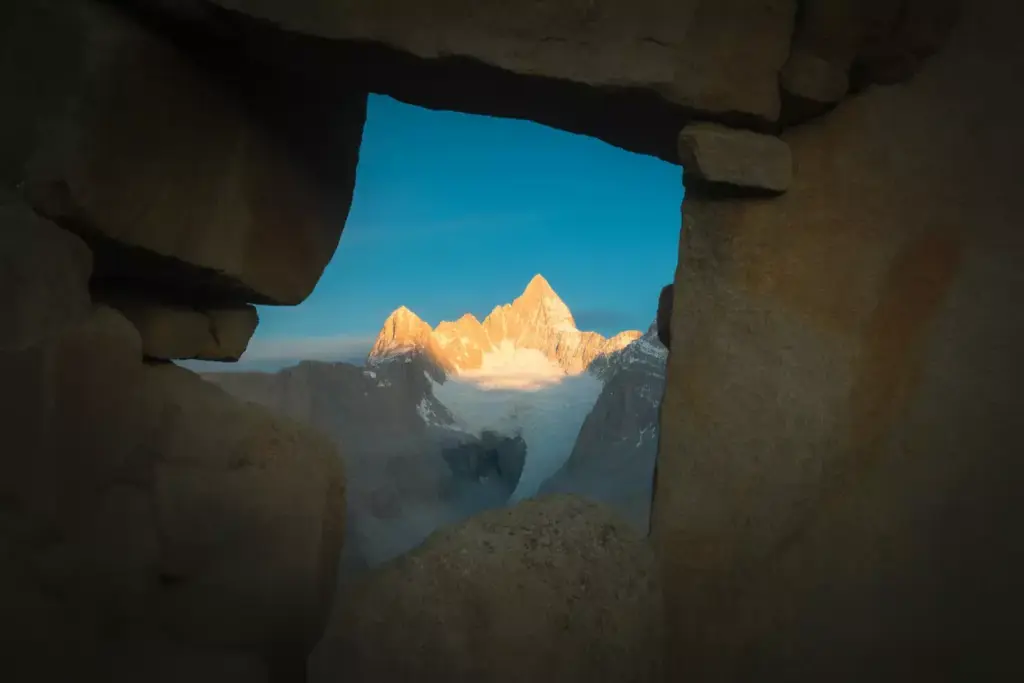
Creative framing transforms ordinary mountain views into extraordinary photographs by utilizing natural elements as compositional tools. Rock arches, tree branches, or cave openings can frame distant peaks while adding visual interest to the immediate foreground.
Perspective changes dramatically affect mountain photography impact. Moving just a few feet can transform compositions by aligning distant peaks, eliminating distracting elements, or improving foreground relationships. Successful mountain photographers constantly evaluate scenes from multiple viewpoints before committing to specific compositions.
Framing strategies:
- Natural frames: Use rock formations or vegetation to border compositions
- Vertical compositions: Emphasize peak height and dramatic sky elements
- Panoramic formats: Capture expansive ridge lines and valley systems
- Intimate landscapes: Focus on detailed mountain features and textures
Technical Settings and Exposure Management
7. Hyperfocal Distance and Focus Stacking
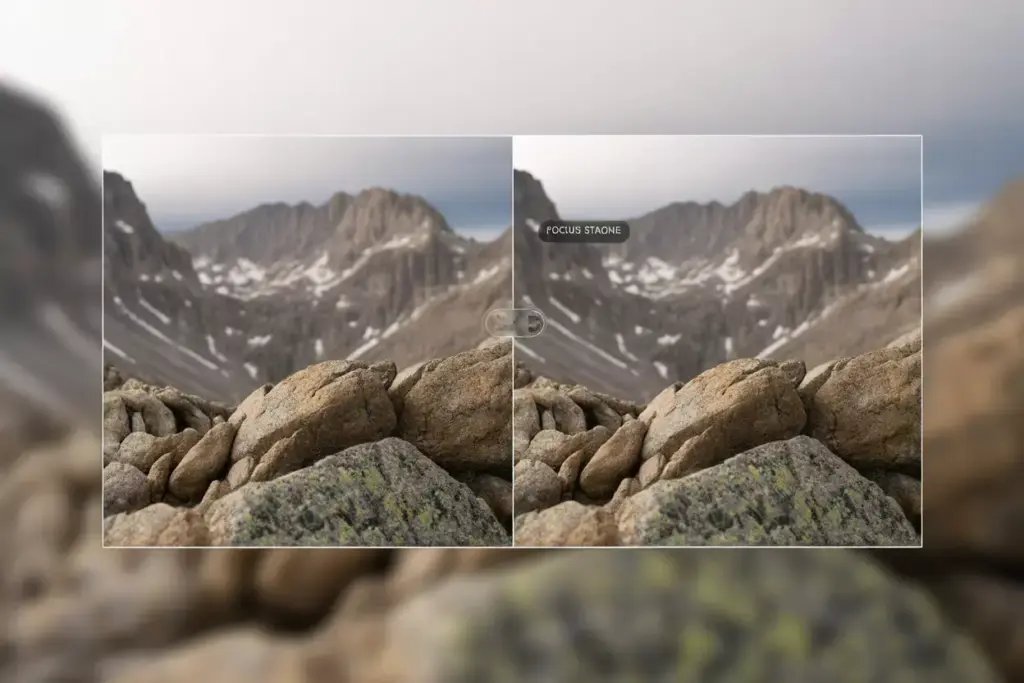
Achieving sharp focus throughout mountain compositions requires understanding hyperfocal distance principles and advanced focusing techniques. The hyperfocal distance represents the closest focusing point where everything from half that distance to infinity appears acceptably sharp at a given aperture.
Focus stacking provides an alternative approach for situations where single-exposure depth of field proves insufficient. This technique involves capturing multiple images at different focus points, then blending them during post-processing to achieve front-to-back sharpness impossible with traditional methods.
Focus optimization techniques:
- Hyperfocal apps: Use smartphone calculators for precise focus distances
- Live view magnification: Ensure critical focus on key compositional elements
- Back-button focus: Separate focus and exposure controls for consistent results
- Focus peaking: Utilize camera features to visualize sharp areas
8. Exposure Strategies for High Dynamic Range Scenes
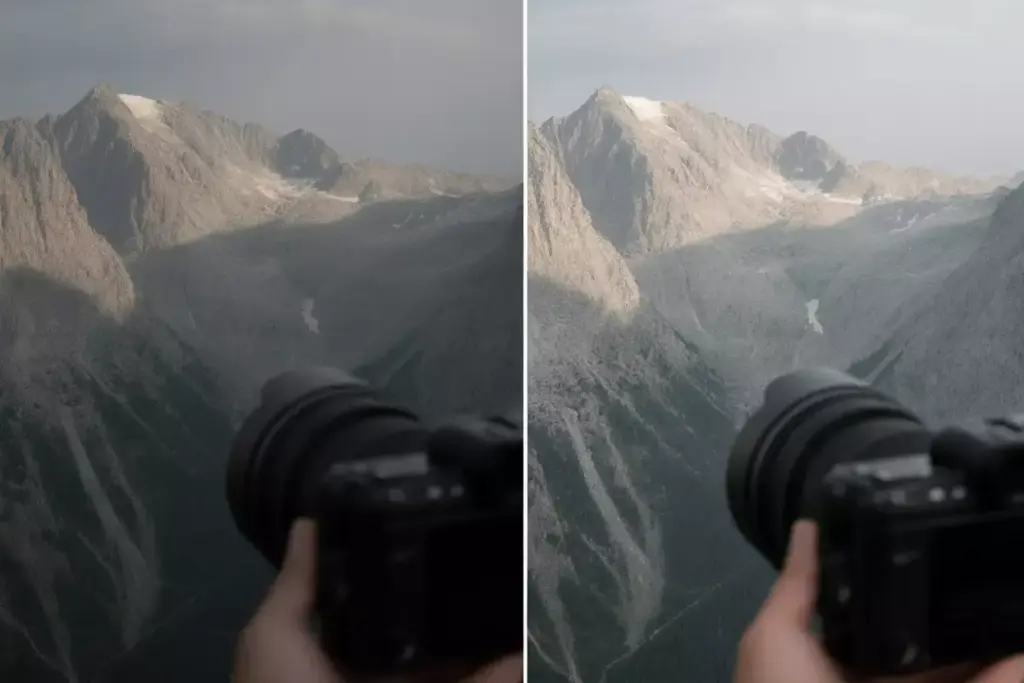
Mountain landscapes frequently present extreme dynamic range challenges, with bright snow-covered peaks contrasting against deep shadowed valleys. Traditional single-exposure techniques often result in blown highlights or blocked shadows that compromise image quality.
Graduated neutral density filters help balance exposure differences by darkening bright sky areas while maintaining proper exposure for foreground elements. Exposure bracketing and HDR processing provide additional tools for managing challenging lighting conditions common in mountain environments.
Exposure management tools:
- Graduated ND filters: 2-3 stop density for sky/land balance
- Polarizing filters: Reduce reflections and enhance sky contrast
- Exposure bracketing: Capture multiple exposures for HDR processing
- Histogram monitoring: Ensure optimal exposure without clipping
Safety Considerations and Practical Tips
Mountain photography involves inherent risks that require careful planning and preparation. Weather conditions can change rapidly at elevation, potentially creating dangerous situations for unprepared photographers. Always inform others of planned routes and expected return times, carry emergency communication devices, and understand basic mountain safety principles.
Equipment protection becomes crucial in harsh mountain environments. Sudden temperature changes can cause condensation inside camera bodies, while blowing snow or rain can damage sensitive electronics. Protective covers, silica gel packets, and gradual temperature transitions help preserve equipment functionality.
Essential safety gear:
- Navigation tools: GPS device, compass, and detailed topographic maps
- Emergency shelter: Lightweight bivy or emergency blanket
- Communication: Satellite messenger or personal locator beacon
- Weather protection: Waterproof camera covers and lens cloths
Post-Processing Workflow for Mountain Images
Raw image processing plays a crucial role in realizing the full potential of mountain photographs. RAW files capture significantly more dynamic range than JPEG images, providing flexibility for highlight recovery and shadow detail enhancement during post-processing.
Color grading techniques can enhance the natural beauty of mountain scenes while maintaining realistic appearances. Subtle adjustments to color temperature, vibrance, and luminosity help recreate the emotional impact experienced during capture.
Processing workflow steps:
- RAW development: Optimize exposure, highlights, and shadows
- Local adjustments: Enhance specific areas using masking tools
- Color grading: Fine-tune color relationships and mood
- Sharpening: Apply output-specific sharpening for intended use
Building Your Mountain Photography Portfolio
Developing a distinctive mountain photography style requires consistent practice and critical evaluation of results. Study work by established landscape photographers to understand successful techniques while developing personal approaches to composition and processing.
Portfolio development benefits from focusing on specific mountain regions or themes rather than attempting to document every possible mountain scene. Specialization allows photographers to develop deep understanding of local conditions while building recognition for expertise in particular areas.
Portfolio building strategies:
- Consistent style: Develop recognizable processing and composition approaches
- Seasonal coverage: Document locations across different seasons and conditions
- Technical excellence: Ensure sharp focus and optimal exposure throughout
- Storytelling: Create images that convey emotional connections to mountain environments
Conclusion
Mastering these 8 Mountain Trekking Photography Tips for Stunning Landscape Shots requires dedication, practice, and respect for mountain environments. Success comes from combining technical expertise with artistic vision while maintaining safety awareness during challenging mountain conditions. The investment in proper equipment, technique development, and safety preparation pays dividends through a lifetime of rewarding mountain photography experiences.
Take action today by planning your next mountain photography adventure. Research potential locations using topographic maps and weather forecasts, ensure your equipment meets the demands of mountain environments, and practice these techniques in local areas before attempting challenging remote locations. Remember that the most stunning mountain photographs result from patience, preparation, and persistence rather than luck or expensive equipment alone.
The mountains offer endless opportunities for photographers willing to invest the effort required for truly exceptional landscape images. Start implementing these techniques on your next trek, and watch as your mountain photography transforms from simple documentation into compelling artistic expression that captures the raw beauty and emotional power of these magnificent landscapes.